

Catalog


Although Byzantium was originally founded as a Greek colony in 667 BC and named after the Greek King ‘Bizas’, the Byzantine Empire is the term used to describe the East Roman Empire (or Nova Roma) of which the capital was named Constantinople in 330 AD after Constantine the Great. From this point on until the capturing of Constantinople in 1453 ...
Although Byzantium was originally founded as a Greek colony in 667 BC and named after the Greek King ‘Bizas’, the Byzantine Empire is the term used to describe the East Roman Empire (or Nova Roma) of which the capital was named Constantinople in 330 AD after Constantine the Great. From this point on until the capturing of Constantinople in 1453 by the Ottomans, the synthesis of classical Greek, Roman and Christianized Roman culture created unrivaled achievements in art, architecture and magnificent jewelry.
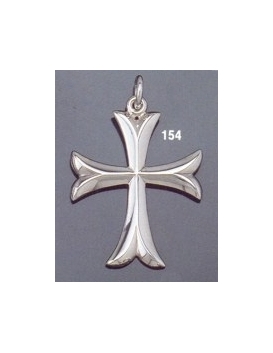
Byzantine Crosses were later borrowed by other cultures. From the time of the crusades, shortly after Byzantium, many cross designs were adopted emblematically by the knights templar. The classification of the most usual type of crosses used by the Knights templar and as other fraternal and masonic symbols is the 'cross patée'. (A cross which has narrow arms towards the center, that broader outwards towards the edges).
Our range offers a wide selection of Byzantine Crosses, Baptism Crosses and jewelry of the Greek Orthodox faith which tell their own story of heritage and traditional craftsmanship in typical Byzantium Rhythm. This category will frequently be enriched with new designs.
Byzantine Crosses There are 55 products.
-
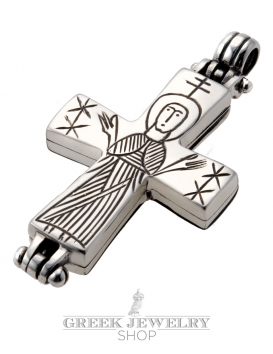
650 Sterling Reliquary Cross Pendant
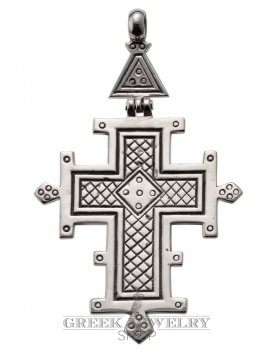
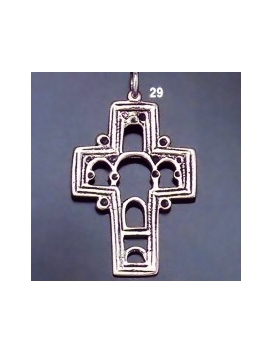
An extraordinary piece of historic religious jewelry. It is very rare to see a perfectly working reconstruction of a Byzantine reliquary cross. This exquisite heavy pendant is a masterpiece reconstruction from the Byzantine museum in Thessaloniki.
-
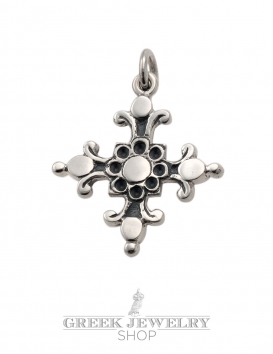
28 Double-Sided Solid Silver Ornate...
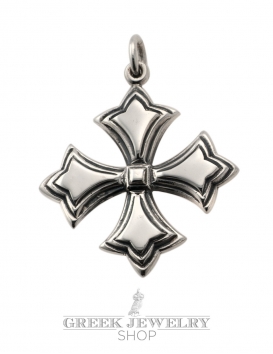
A uniquely characteristic Byzantine ornate 'cross pattée' cross from solid silver. Double sided and solid. This particular cross design is seen in wall paintings on the ceiling of Hagia Sophia in Constantinople in a section from the upper floor.
-
-
-
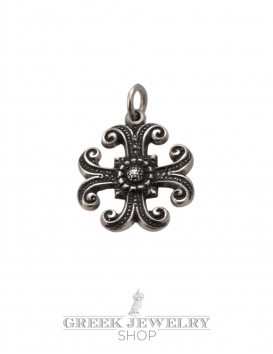
737 XL Impressive Solid Sterling Silver...
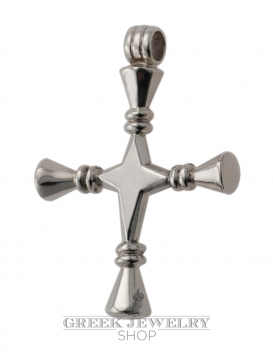
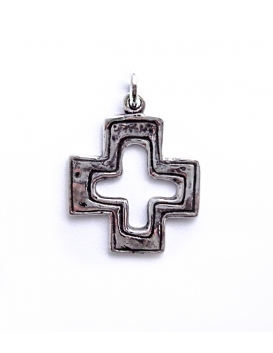
A solid silver Greek cross has a beautifully minimal geometric structure and elegant simplicity.
-
-