



Wearing silver coins as a pendant or necklace is hardly a new style. In fact Greek coins were worn as adornment and as jewelry in ancient Greece not for their value of being ancient at the time but for their beauty. Ancient coins were from precious metals (silver or gold) and carved with true skill and craftsmanship by the best artists of the ti...
Wearing silver coins as a pendant or necklace is hardly a new style. In fact Greek coins were worn as adornment and as jewelry in ancient Greece not for their value of being ancient at the time but for their beauty. Ancient coins were from precious metals (silver or gold) and carved with true skill and craftsmanship by the best artists of the time to comprise assets of value that were also wearable works of art.
Greek Jewelry Shop's fine selection of coin pendants are carefully reproduced with great expertise and a high quality of craftsmanship and have vivid detail unlike most knock-off coin pendants on the market. The actual ancient coin prototypes come the finest silver and gold artifact coins found in museums. Each pendant is produced by expert artisans in our own family workshop. Many of our silver coins travel to be offered at exclusive museum shops and jewelry shops worldwide.
Depicted on ancient silver and gold coinage were mighty kings (such as Alexander the Great) or characters from mythology, (such as the Goddess Athena, Pegasus or the owl of wisdom). Of course our coin collection is much larger than these more popular and common themes.
Besides their nominal value, coins in the ancient world also symbolized via their depiction the values and ideals of the region and period of Greek history. The potential beauty of money is possibly a little hard to understand in today's cultural viewpoint which has been affected by long lasting intermittent Judeo-Christian influences. These more likely than not, casting the complex idea of physical money itself as being ethically ambiguous, shameful and even dirty beyond the physical sense. In ancient Greek life however, as the ethics and principles of Greek philosophy and mythology were less fragmented, beauty found a sincere form of existence in coinage which went hand in hand with jewellery and adornment.
Discover the Greek within with a Greek silver coin pendant inspired from antiquity and beyond from our vast online shop selection.
Coin Pendants There are 208 products.
Subcategories
-
Classic coin pendants
Our classic coin pendants have the predominant feature of the coin itself without any bezels or mounts around the centerpiece. Discover some of the most beautiful specimens of Greek coin jewelry and coinage medallions in our unique classic pendants range.
-
Bezel mounted coin...
This classic way of wearing a coin was the preferred way that coin medallions were worn in antiquity. Whether a coin is a genuine artifact or a fine artistic reproduction, it is a token of value. Treated as such, the primary idea of a silver or gold bezel mount is to preserve the coin itself without altering or piercing the inner coin. In jewelry making, coin bezels are also used to protect the mounted show-piece from being damaged while wearing. Finally, bezel mounts from precious metals often accentuate the beauty of coins visually provide a more vivid and dramatic presentation. This is why some of our most popular pendants can be found in this category.
-
Greek-key (Meander)...
The Greek-Key (otherwise known as a Meander or 'Μαίανδος' pattern) became a popular form of decoration in the Greek Classical period and carried through to the Hellenistic period. Meander was a river deity but also a symbolism of how the realm of common mortals managed to touch the realm of the gods. It also has a binary sense of duality much like the 'Ying-Yang' symbol in Chinese philosophy as one element complements the other perfectly.
-
Gold plated Greek key...
This gold plated variation of our coin collection features a number of the most popular ancient coin pendants in gold plated matte-finish versions. Naturally the entire pendant material is sterling silver and the quality of these pieces matches our the rest of our items and our reputation.
As many jewelry appreciators may know, gold plated silver is quite frequently a disappointment (particularly for pendants) as the increased contact with the skin (acidity of sweat, perfumes etc) generally is known to cause gold plating to fade quickly. However from our experience the best way to do this was to allow the silver meander mount to shield and protect the inner coin from high contact. The result was even better than we expected due to the beautiful contrast created between the vivid gold color and the silver. This delightful contrasting effect is furthermore characterised by the difference between the treatment of surfaces (matte vs glossy outer Greek-Key bezel).
-
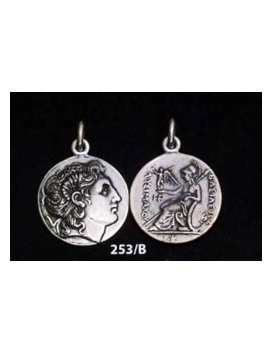
253/B Alexander the Great portait coin...
The obverse shows the head of Alexander the Great, wearing horn of Ammon. The reverse shows the goddess Athena enthroned seated left holding Nike and resting hand on shield.
-
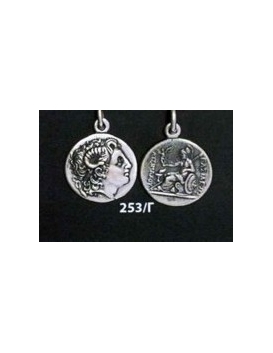
253/C Alexander the Great portait coin...
The obverse shows the head of Alexander the Great, wearing horn of Ammon. The reverse shows the goddess Athena enthroned seated left holding Nike and resting hand on shield.
-
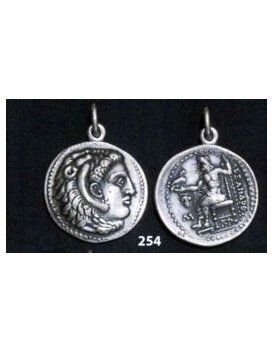
254 Alexander the Great Coin Macedonia
As with all of Alexander's imperial tetradrachms, the obverse of the above coin depicts a young (beardless) Herakles/Hercules wearing a lion skin headdress, with the lion's paws tied at his neck.
-
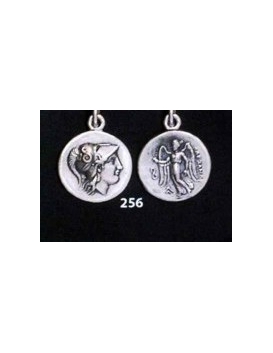
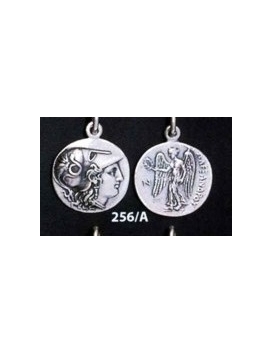
256 Alexander the Great stater, Helmetted...
Alexander the Great lifetime stater, Asia Minor, c. 328-323 BC
-
-
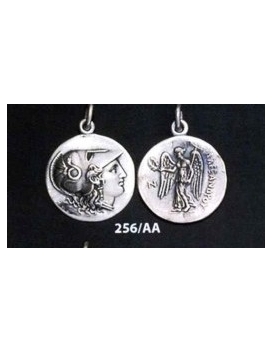
256/AA Alexander the Great stater,...
Alexander the Great lifetime stater, Asia Minor, c. 328-323 BC
-
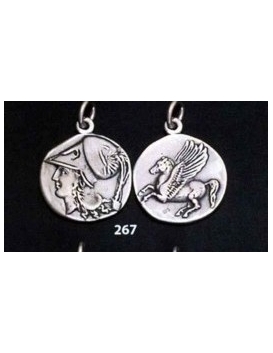
267 Corinth stater coin Athena and pegasus
obverse Pegasos flying left, koppa below, reverse helmeted head of Athena right.
-
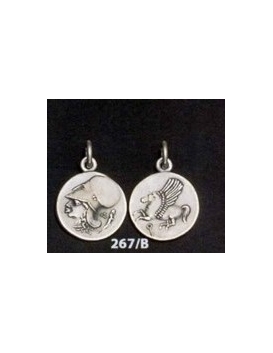
267/B Corinth stater coin Athena and pegasus
Silver stater, Pegasi /pegasus Corinth mint, c. 345-307 B.C.; obverse Pegasos flying left, koppa below; reverse helmeted head of Athena right.
-
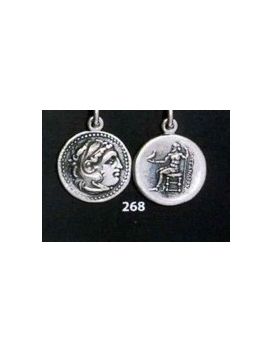
268 Alexander the Great Coin (Hercules...
As with all of Alexander's imperial tetradrachms, the obverse of the above coin depicts a young (beardless) Herakles/Hercules wearing a lion skin headdress, with the lion's paws tied at his neck.
-
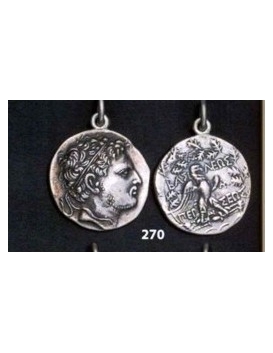
270 Perseus of Macedon tetradrachm
Kingdom of Macedon, Perseus, 179-168 BC, AR Tetradrachm. Struck after 171 BC. Diademed head of Perseus right with close beard
-
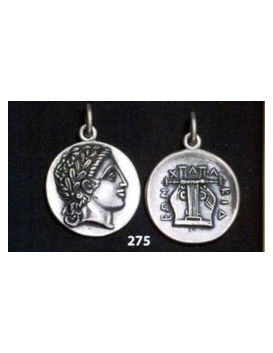
275 Chalkidian League god Apollo and...
Macedon, Olynthos. Chalkidian League. Circa 395-392 BC. AR Tetradrachm. Laureate head of Apollo right / CAL-KID-EWN, kithara (guitar)
-
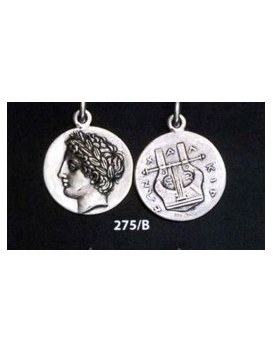
275/B Chalcidian league, god Apollo
Macedonia, Chalcidian League AR Tetradrachm. ca 380-370 BC. Laureate head of Apollo left / Cithara. X-A-L-KID-EWN