

Greek gods Jewelry
Catalog


Inspired by Greek gods and mythology? We have something to inspire everyone with a piece of Greece in them from the pantheon of the mighty gods of Olympus, minor gods and demi-gods. Whether you're pampering your inner wise Athena goddess, calling out to the creative muses of god Apollo, or befriending the power of mighty Zeus you are bound to fi...
Inspired by Greek gods and mythology? We have something to inspire everyone with a piece of Greece in them from the pantheon of the mighty gods of Olympus, minor gods and demi-gods. Whether you're pampering your inner wise Athena goddess, calling out to the creative muses of god Apollo, or befriending the power of mighty Zeus you are bound to find a high-quality jewelry item to accompany your quest and complement your unique style.
Discover all of our exquisitely made jewelry feature the Greek Olympian gods. Among these, Apollo - the god of Music and prophesy, Athena - goddess of wisdom, Hermes - protector of trade and patron of literature and poetry, Zeus - the lord of the sky and ruler of all gods and mortals - and many more in our new Greek gods collection!
Greek gods Jewelry There are 212 products.
Subcategories
-
Goddess Athena Jewelry
Athena is one of the most inspiring Greek gods. She is the inspiring goddess of wisdom, courage, and in inspiration itself! Athena embodied and inspired civilization, law and justice, strength, war strategy, mathematics and the arts. Finally Athena is the defender of heroes and the protectress of civilized life, including artisanal and creative activities.
Athena is possibly the most well known Greek goddesses and one of the most celebrated and honored in ancient Greece and beyond. The Romans later called her Minerva. Athena gave birth to the olive tree and to the desire for peace. All of the her values (civilized life, strength, justice, wisdom, etc) were to be encapsulated in the city of Athens (which she also gave birth to) and which was named 'Αθηνα' in her honor. Athens was the pride of the civilized world and the city flourished in the golden age becoming the economic, military and cultural center. As Patron of this city, the Parthenon (the pinnacle of classical architecture itself) was built in her honor on top of the Acropolis hill employing more riches than any other building ever made before. Societies were predominantly male run at the time, so the conceptualization of Athena as the giver of wisdom, intelligence and creativity was extremely advanced. Athena was wiser than any of the other gods and not in the least intimidated intimidated by her male counterparts.
Goddess Athena related symbols
The symbols of the goddess is the all seeing Greek owl of wisdom and the olive branch (depicted with the goddess on several rings and coin pendants). These reflect her commitment to maintaining and promoting Wisdom, intelligence and peace.
Depictions of Athena commonly on coins (ring, pendant and necklace depiction styles)
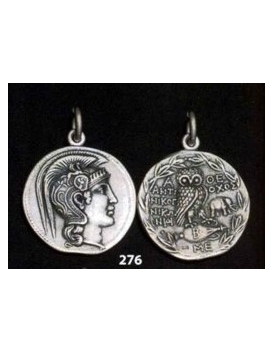
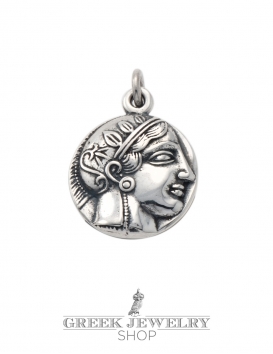
The style of Athena's depiction varies on coinage according to period and region (unlike most other gods she was worshiped in vary many Greek cities of the time). Ancient coins from Athens frequently depict the Greek goddess with the almond shaped eye (as old as the archaic period) and with her owl of wisdom on the reverse such as the Athenian tetradrachm. We have a dedicated sub-category of jewelry designs with Athena 'helmeted' from coins the Classical and Hellenistic period, for example on Corinthian coins Athena is depicted wearing a Corinthian helmet and with Pegasus on the reverse. In Alexander's empire she is depicted on gold Stater coins helmeted (denomination) usually with the winged goddess Nike (Victory) on the reverse.
Our goddess Athena jewelry collection
A significant proportion of our jewellery collection is dedicated to this inspiring Goddess, comprising possibly the largest and richest selection of quality made Athena jewelry online. The quality of our Athena ring jewelry and Athena coin pendants is unsurpassed among Greek jewelry designers. Our exclusive hand-made range is populated with an extraordinary amount of ring and necklace variations devoted to Athena. It even includes several niche goddess Athena jewelry types such as brooches and male jewelry and collector's items. Hope you enjoy the largest and finest Athena collection available online!
-
Helios
Helios was a Titan god and personification of the sun (latin name Sol). He was the son of Titans Hyperion and Theia, and brother to Selene (the moon) and Eos (dawn). Helios was also a handsome god who rode his fiery chariot through the sky by day and traveled the oceans from west back to east by night. He is often mistakenly identified as the Olympian god Apollo (the light giver) but is actually a much older mythological entity.
In one famous story Helios' son Phaethon, stole the chariot of his father and lost control of it setting the earth on fire. In another, Helios upset by the men of Odysseus (Ulysses) for eating his own sacred flocks of cattle and sheep, appeals to Zeus and asks him to reward punishment on the men - or threatens to shine his light on the underworld. Zeus gives in and kills all of Ulysses' men by thunderbolt sparing just Ulysses.
The cult of sun worship is generally not commonly associated to Greek culture but to pre-Hellenic culture. Helios however was still acknowledged as a god because he was worshiped (almost exclusively) by the inhabitants of city island of Rhodes. Not only does he appear on the most ancient coinage of this Greek island, but the Colossus of Rhodes itself was made in his dedication.
Greek Jewelry shop's vast selection of Helios the sun god of Rhodes jewelry features a breath-taking selection of beautifully hand-crafted Helios ring jewelry, Helios necklaces and pendants and other Helios related items all made in our traditional Athens based jewelry workshop.
-
Apollo
Apollo was one of the most important gods of the 12 Greek gods of Olympus and with one of the most complex and multi-faceted characters. Apollo was recognized by man as a the god of music and truth. He was also the protector of healing, and associated to light, poetry, and prophesy.
As the bearer of light Apollo is considered a protector from evil, disease and misfortune. His name in ancient Greek according to Plato originates from Redemption and Purification. Because by legend he had been born on the island of Delos, the island was so sacred that no mortal was allowed to be born or to die on its earth. The Delians were very careful to uphold this sacred law. After all Apollo who had the power to heal, also had the power to spread disease and famine if he was displeased or dishonored.
Apollo is often depicted on vases and vessels playing his musical harp 'lyra'. He is a healer and a musician. The two are combined into a magic tune of healing. (Similar in Hinduism to a mantra). Music was considered to be of divine origin and used as a healing method for men and women at the many temples of Apollo.
Perhaps the most important place of worship of this god was the temple of Apollo in Delphi, which attracted the entire ancient world twice a year as a pilgrimage to his shrine and to his world famous Delphic Oracle. This was a very cosmopolitan event for the developed world and the festivities would last for days. It was here that the Oracle (a priestess dedicated to Apollo, god of prophesy) who would tell kings whether it was a good time to go to war, or investors whether it was a good time to expand their trade.
-
Zeus
Zeus was the god of gods and humans and was adored across the ancient world (the Romans called him Jupiter). He was all powerful and dominant, although often temperamental. His promiscuity was notorious, having many offspring with many many partners giving birth to all sorts of tantalizing mythology and stories. Zeus was also the patron of hospitality, and avenger of bad things done to strangers. Hence in ancient Greece travelers were most often treated with respect and it was considered unmanly to harm a traveler who is away from his homeland and might be at temporary disadvantage.
In origin, Zeus was the son of Titan god Cronus (latin Saturn) and Titan goddess Rhea (meaning Flow) As Cronus ate most of his children he was saved by Ghea (meaning Earth) who saved him from death. We was then raised by a number of Nymphs, most notably Adamanthea. As Cronos ruled the earth, heavens and sea, Adamanthea hid and saved Zeus as a boy by hanging him from a rope from a tree. Suspended between earth, sea and sky he would thus be invisible to his father.
At manhood after forcing his father to release the brothers of Cronos, Zeus in appreciation was rewarded by the Cyclops with the power of the thunderbolt. The Titans were eventually defeated by the cyclops and were into a dark underworld called Tartarus. Atlas, the titan who had fought against Zeus was punished by having to hold up the sky for eternity.
Zeus was all powerful and dominant and had the power to disguise himself in many ways. The animals which he was associated with was the bull (Minoan cult) and the eagle. In coinage apart from Zeus portraiture (below), he also is frequently seen seated in his throne on the reverse of Alexander the Great coins.
-
Hercules
Although Heracles (Hercules) was a son of Zeus, he was actually mortal because his mother Alcmene was also a mortal. He is famous in classical mythology for his godly strength and for his heroic far-reaching adventures and feats.
Hercules, the illegitimate son of Zeus was driven mad by Hera (the wife of Zeus) as an act of her jealousy. Hercules in madness slew his own wife and his six sons. With partly recovered sanity, Hercules visited the Pythia (Oracle) at Delphi to inquire about how he could atone for his actions. The oracle advised him to go to King Eurystheus in Tirins and serve him for twelve years and do whatever the king instructed him to do. During this time, Heracles performed his twelve labours and was eventually cleansed. The feats considered impossible deeds for any mortal included the slaying of the Nemean Lion and the slaying of the 8 headed Lernaean Hydra.
In coinage, Hercules is frequently found on Alexander the Great period coins wearing the slain Nemean Lion headpiece as a battle trophy. The image was popularly associated to Alexander himself who was seen as having a piece of Heracles' strength.
Hercules knots were also a decorative ornament throughout the Hellenistic world that invoked the strength, virility and heroism of the god.
Our rich selection of Hercules jewelry features a vast selection of finely made jewelry and signature items including Hercules Rings, Hercules necklaces and Hercules pendants as well as other silver collectibles featuring the mighty Greek demi-god.
-
Dionysus (Bacchus)
Dionysus was the patron god of harvest, wine, theater, ecstacy and eroticism. He was in many ways the opposite of Apollo (god of light), representing the darker but nonetheless present side in all of us. Dionysean festivities were considered important rituals and usually took place in autumn or winter. At the Dionysian cult festivities, wine, music and ecstatic dance would free the inhibitions. He was considered the liberator, that freed his followers from self-conscious fear and care, subverting the oppressive restraints of oneself and of others.
In fact these festivities were the driving force behind the development of Greek theater itself - as acting considered to be a form of escaping from oneself. He was also the patron of those who do not belong to conventional society and hence symbolizes everything which is chaotic or unexpected, everything which escapes human reason and which can only be attributed to the unpredictable action of the gods. Dionysus's following usually includes wild women (Maenads) and naked satyrs with erect penises.
Dionysus (Bacchus in latin or Dionysos in Greek) was the only half mortal god to be allowed on mount Olympus (his mother was a mortal). His father was Zeus and his mother, the mortal Semele. He is frequently depicted as a bearded man in earlier appearances and as a more sensuous, naked androgynous figure later on. His thrysus (staff) is depicted wrapped in Ivy and dripping with honey. It is a beneficial wand to some and can be used as a weapon to others who try to oppose the freedoms he represents.
-
Aphrodite (Venus)
Aphrodite (Venus later by the Romans) was the goddess of Beauty. She was so beautiful that the other gods feared rivalry over her might ruin the peace and drive the gods to war. Therefore Zeus married her off to Hephaestus who was so ugly and deformed, could not possibly be seen as a threat. Despite this, Aphrodite had many lovers among which were Hermes, Aries and the handsome Adonis.
. In a fierce competition between the goddesses over the 'apple of discord' a golden apple is thrown at the goddesses inscribed 'to the fairest'. Passionately three godesses all claim the apple. These were Hera, Athena and Aphrodite, and so Zeus not wanting to get involved in this feud of his wife and daughters appoints the decision for a mortal to decide, Paris.
All 3 godesses try to bribe Paris with powers. Hera offers him power, Athena offers him wisdom glory and heroic victory over his enemies in battle and finally Venus offers him Helen.. the most beautiful mortal woman in the world. Blinded by the power of Aphrodite and by Helen's beauty, Paris chooses Helen of Troy and this leads to the Trojan wars.
-
Hermes (Mercury)
The Greek god Hermes is regarded as one of the 'sneakier' Greek gods. As the emissary (or messenger) of the gods, he moved freely between the world of the gods and the world of the mortals.
He was patron to: oratory and whit (hence the sneaky character), poetry and literature, athletics and sports and last but not least, invention and trade.
Additionally, (and perhaps notoriously), the great orator, inventor and master of trade was also the protector of thieves! (you can always expect to find such entertainingly ironic elements in Greek mythology!)
-
Arethousa / Persephone...
This coin is widely considered one of the most beautiful coins ever minted by the ancient Greeks. Depicted is Arethusa, the patron nymph of Syracuse, a nereid (water nymph) and she is most often surrounded by dolphins in coin depictions.
Arethousa (Arethusa) was known to pass her time in the waters near Olympia but one day became pursued intensely by the river-god Alpheios. She ran for advise to the goddess Artemis goddess of hunting and also the protector goddess of women (Roman Diana). Artemis instructed her to go to Ortygia (Syracuse) by creating a fresh water stream under the sea and a spring water spring in Syracuse where she emerged. Hearing of this Alpheios diverted all of his river water across the sea to Syracuse to meet and mingle with her waters forever at the fountain of Arthousa in Ortygia.
The persona of Arethousa is frequently identified with Artemis (huntress and protectress of women) and also with Persephone (the goddess of springs, and queen of the underworld).
-
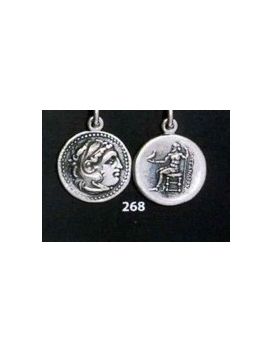
268 Alexander the Great Coin (Hercules...
As with all of Alexander's imperial tetradrachms, the obverse of the above coin depicts a young (beardless) Herakles/Hercules wearing a lion skin headdress, with the lion's paws tied at his neck.
-
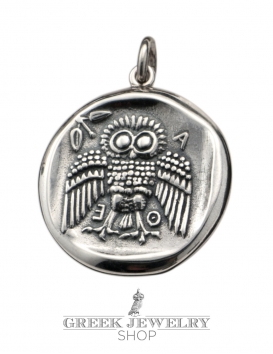
273 Athens dekadrachm - Athena and the owl...
Dekadrahm of Athens, struck in 465B.C. at end of Persian wars, honoring the patron goddess Athena shown here in crested helmet; owl on reverse side.
-
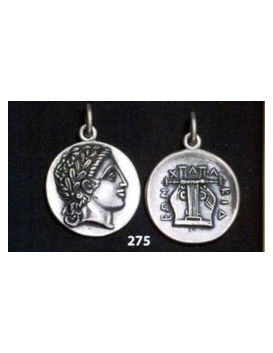
275 Chalkidian League god Apollo and...
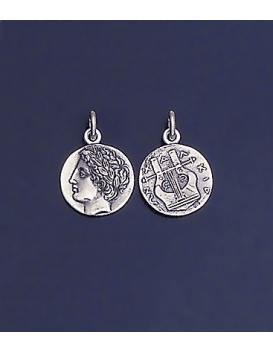
Macedon, Olynthos. Chalkidian League. Circa 395-392 BC. AR Tetradrachm. Laureate head of Apollo right / CAL-KID-EWN, kithara (guitar)
-
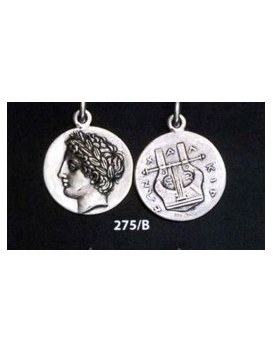
275/B Chalcidian league, god Apollo
Macedonia, Chalcidian League AR Tetradrachm. ca 380-370 BC. Laureate head of Apollo left / Cithara. X-A-L-KID-EWN
-
275/BB Chalkidian League god Apollo and...
Macedon, Olynthos. Chalkidian League. Circa 395-392 BC. AR Tetradrachm. Laureate head of Apollo left / CAL-KID-EWN, kithara (guitar)
-
275/C Chalkidian League god Apollo and...
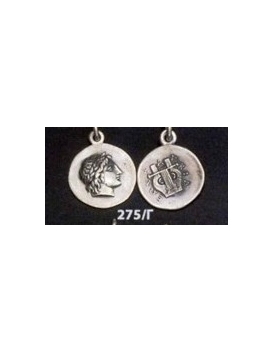
Macedon, Olynthos. Chalkidian League. Circa 395-392 BC. AR Tetradrachm. Laureate head of Apollo right / CAL-KID-EWN, kithara (guitar)
-
-
309 Athens tetradrachm, Athena & Wise Owl...
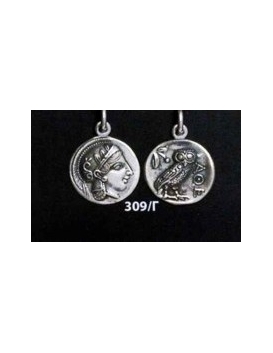
Athena Tetradrachm originally minted 431-413 BC and depicting the wise owl.
-
309/C Athens tetradrachm, Athena & Wise Owl
Athena Tetradrachm originally minted 431-413 BC and depicting the wise owl.
-
309/CC Athens tetradrachm, Athena & Owl of...
Athena Tetradrachm originally minted 431-413 BC and depicting the wise owl.
-
310 Aphrodite (Venus) coin pendant
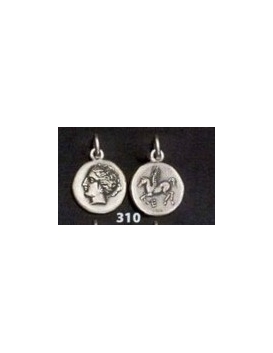
Theme: c. 400-350 BC drachmae Corinth (central Greece).Pegasus raised wing left, reverse; head most often identified as Aphrodite left.
-
312 Alexander the Great Coin Macedonia
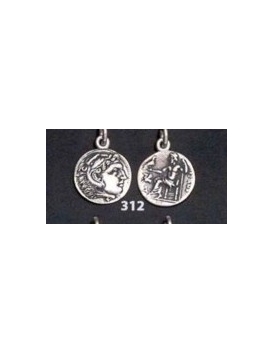
As with all of Alexander's imperial tetradrachms, the obverse of the above coin depicts a young (beardless) Herakles/Hercules wearing a lion skin headdress, with the lion's paws tied at his neck.