


 View larger

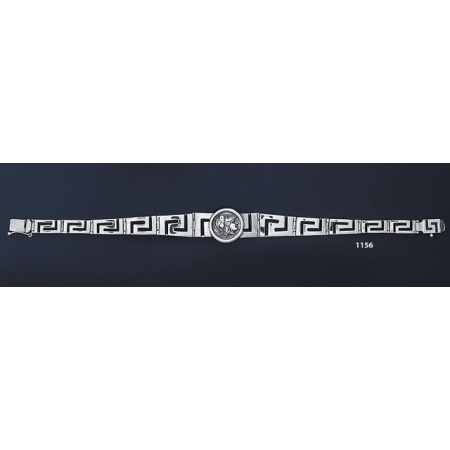
1156 Greek Key / Meander Silver Bracelet with Helmeted Athena Coin
1156
New product
Greek Key / Meander Silver Bracelet with Helmeted Athena Coin
Data sheet
| Article group | Bracelets |
| Gender | For Her |
| Depiction | Athena (Helmeted) |
| Historic Period | Era: Hellenistic |
| Material | Solid Sterling Silver |
| Inner (coin) diameter | 13 mm (33⁄64in) |
| Bracelet fit | Standard female. 15 cm - 17 cm wrist (5 &15/16 inches - 6 & 11/16 inches) - Fits most ladies |
More info
Helmeted Goddess Athena: Alexander the Great lifetime stater, Asia Minor, c. 328-323 BC,depicts Athena wearing a crested Corinthian helmet ornamented with a coiled snake, wearing an earring and a necklace, her braided hair falling straight down the back of her neck and visible as wavy locks beneath her helmet to the side.
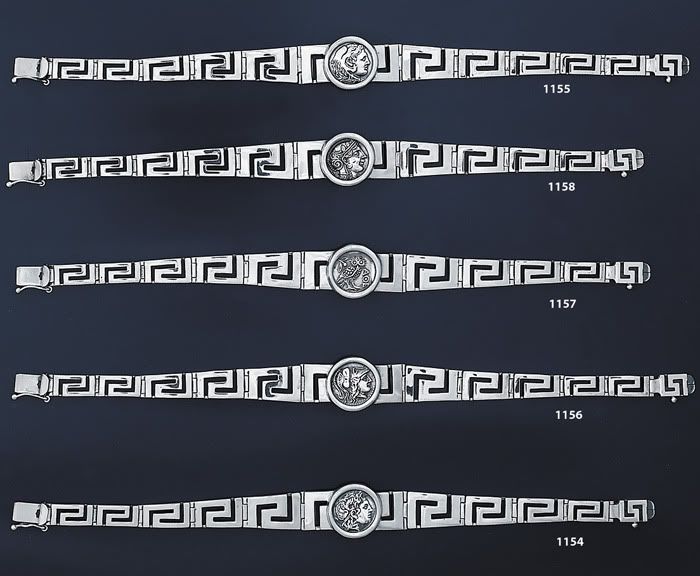
The Greek key pattern (also meander or meandros) takes its name from the square pieces that repeat in the pattern that look rather like an old fashioned key. The pattern is also known as a meander or a Greek fret. Meander means twisting and turning.
Meanders were among the most important symbols in ancient Greece; they, perhaps, symbolized infinity and unity; many ancient Greek temples incorporated the sign of the meander. Greek vases, especially during their Geometric Period, were likely the genesis for the widespread use of meanders; alternately, very ocean-like patterns of waves also appeared in the same format as meandros, which can also be thought of as the Guilloche pattern. The shield of Philip II of Macedon was decorated with multiple symbols of the meander; the shield itself can be found in the museum of Vergina in Central Macedonia of Greece.