


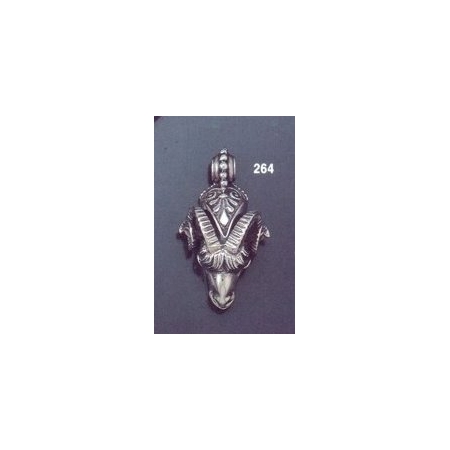



264 Ram's head torc pendant
264
New product
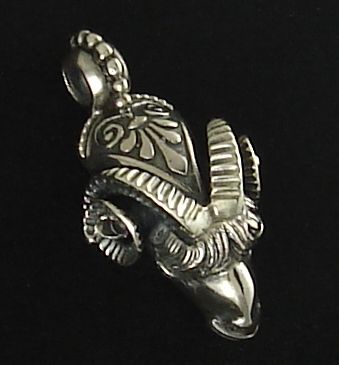
Ram's head torc pendant. A museum quality reproduction in 925 Sterling Silver
Data sheet
| Article group | Pendants |
| Gender | For Him or Her |
| Depiction | Rams |
| Historic Period | Era: Hellenistic |
| Material | Solid Sterling Silver |
| Length (top to bottom excluding bails or hooks) | 31 mm (1 and 7⁄32in) |
| Length (top to bottom including bails or hooks) | 38 mm (1 and 1⁄2in) |
| Depth | 13.5 mm (35⁄64in) |
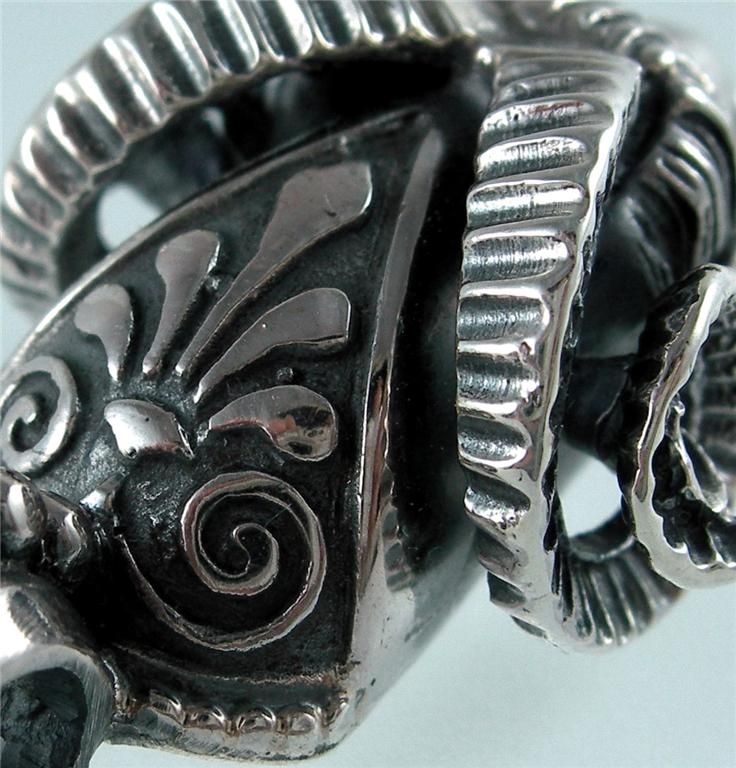
| Workshop's comment | Sharp and intricate & detailed. All-round an eye-catching sensational piece of work that stands out from common grade silver jewelry. Reverse appearance is flat glossy silver. |
| Weight | Approx 11-13 grams (varies as hand made) |
More info
This piece belongs to a fabulous range of torc jewelry that our workshop boasts a speciality towards. Such intricate and quality-made pieces demonstrate the characteristic unique value of greek artisan silversmithery with all its diachronic finess.
Torc jewelry describes ancient jewelry that was open ended in the front (as necklaces or bracelets) and usually contained decorative ornate animal heads on either side of the opening. This item renders the attributes of design and decoration of gold and silver artifacts from the archaic period. There are great similarities found between celtic and Greek torcs of this type, as this rhythm was known to have existed all over Europe. The oldest type of torc (or torque latin) jewelry known were excavated in classical Greek burial tombs. Famous celric torcs, much later were also found in tombs of Celtic princes. Many historians argue that they were a sign of nobility while others suggest the torc to have been a decoration awarded to warriors for their deeds in battle. Before this predominantly masculine form of decoration, torc jewelry is know to have also been a feminine form of jewelry (before 4 B.C)
The significance of the ram
The ram was sacred in various entwined ancient civilisations, from as far back as the mesopotamian civilisation (approx 3000 BC), to the Etruscan, Egyptian and Greek civilizations.The peace-loving and quite mystical Minoans also revered it as an all important symbol of fertility.
Additionally, the ram was seen as the incarnation of the Egyptian god Jupiter-Ammon. When Alexander the Great conquered Egypt he visited the shrine of Ammon (or Amun). Embracing the god, upon his visit and thereon, he dressed himself in his honor with the skin of a ream and the horns as a head-dress. Thereafter the horns of the ram (known as the horn of ammon) were depicted much like a crown in Alexander's portraits and depictions on Alexander's coinage.